
Posted inHealth & Fitness
How a Pair of Dumbbells Got Me Back into My Body
I didn't plan on falling out of love with movement. It just happened the way these things usually…



























I didn’t plan on falling out of love with movement. It just happened the way these things usually do — one skipped workout became a skipped week, then a skipped season. Between work deadlines and the general chaos of adult life, my gym membership turned into a monthly charge I felt too guilty to cancel and too tired to use.
The turning point wasn’t dramatic. It was a Tuesday night, scrolling through my phone at 11 p.m., when I stumbled across a pair of *Sunny Health & Fitness Neoprene Coated Hex Dumbbells*. Nothing fancy — just a simple 5 lb set in a deep plum color, hex-shaped so they wouldn’t roll off my shelf. I added them to my cart almost on impulse, mostly because I was tired of making excuses.
## Why I Chose Home Dumbbells Over a Gym Comeback
If you’ve ever tried to rebuild a fitness habit from zero, you know the hardest part isn’t the workout — it’s getting yourself out the door. I knew myself well enough to admit that “I’ll go to the gym after work” was a promise I kept breaking. So I asked a different question: what’s the smallest possible barrier between me and moving my body?
The answer turned out to be five pounds of neoprene-coated iron sitting on my living room floor.
*A few things sold me on this particular set:*
– *Neoprene coating* — no calluses, no cold metal grip, easier on hands that hadn’t held weights in months
– *Hex shape* — they don’t roll away when set down, which matters more than you’d think on hardwood floors
– *Compact size* — small enough to store in a drawer, so they never became clutter I resented
– *Non-slip texture* — sweaty hands during a HIIT circuit weren’t a dealbreaker
## The First Two Weeks Were Humbling
I want to be honest: five pounds felt embarrassingly light at first, and then embarrassingly heavy about twelve reps in. That’s the thing nobody tells you about starting over — your ego remembers your old strength, but your muscles have to relearn it from scratch.
I started small. Ten minutes before my morning coffee. Bicep curls, overhead presses, some wobbly lunges with the weights at my sides. No gym clothes, no commute, no self-consciousness about who might be watching. Just me, a yoga mat, and two purple dumbbells that lived within arm’s reach of my couch.
By week three, something shifted. I wasn’t dreading the ten minutes anymore — I was looking forward to them. There’s a specific kind of quiet pride in showing up for yourself in small, unglamorous ways, day after day, with nobody clapping for you.
## What I’ve Learned About Building a Home Workout Habit
If you’re on the fence about starting your own version of this, here’s what actually made the difference for me:
4. *Let it be imperfect.* Some days it’s ten minutes. Some days it’s thirty. The goal was never a perfect routine — it was staying in motion.
## A Small Purchase, A Bigger Shift
Looking back, it wasn’t really about the dumbbells. It was about removing every possible excuse until the only thing left standing between me and a healthier routine was, well, me. A cheap, well-reviewed set of neoprene hex dumbbells happened to be the tool that did it — non-slip, easy to store, and just heavy enough to matter.
If you’re stuck in the same rut I was, my honest advice is this: don’t wait for the “right” equipment, the perfect gym schedule, or the motivation to magically show up. Start with something small enough to fit in a drawer and consistent enough to fit into your actual life. The rest tends to follow.
This post contains affiliate links. If you purchase through them, I may earn a small commission at no extra cost to you.
Real talk on postpartum struggles — from sleep deprivation to identity loss. Practical, doctor-backed tips to help new moms cope and heal.
You imagined lullabies and tiny toes. What you got was a body that doesn’t feel like yours, a brain fog thicker than a Monday commute, and a baby who won’t sleep unless they’re touching you. If this is you, take a breath: *postpartum struggles are common, they’re not your fault, and they’re not permanent.*
This guide breaks down the real challenges of the fourth trimester — and gives you practical, doable ways to get through it.
## What Is the “Postpartum Period,” Really?
Most people think postpartum ends at your six-week checkup. In reality, recovery — physically, mentally, and emotionally — can take a full year or longer. Your hormones are resetting, your body is healing, and you’re learning an entirely new identity overnight. That’s a lot for anyone.
## 1. Physical Recovery Feels Like It’s Taking Forever
Whether you had a vaginal birth or a C-section, your body has been through a marathon. Common issues include:
– *Perineal or incision soreness* that lingers for weeks
– *Postpartum bleeding (lochia)* lasting up to 6 weeks
– *Breast engorgement or pain* if you’re nursing
– *Hair loss* around month 3-4 (totally normal — it’s hormonal)
– *Pelvic floor weakness*, including leaking when you sneeze or laugh
*What actually helps:*
– Use a peri bottle with warm water after using the bathroom for the first few weeks
– Ice packs (or padsicles) for perineal swelling
– Stool softeners — nobody tells you, but you’ll want them
– See a *pelvic floor physical therapist*, even if nothing feels “wrong.” It’s preventative, not just corrective.
## 2. Sleep Deprivation Hits Different
You’ve heard “sleep when the baby sleeps,” and you’ve probably wanted to scream at whoever said it. Fragmented sleep affects mood, memory, and even physical healing.
*Practical fixes:*
– Split night shifts with a partner if possible — even 2-3 hours of uninterrupted sleep changes everything
– Accept help for daytime naps: let someone else hold the baby while you sleep, not while you shower
– Skip the “productive” nap-time chores for the first few weeks. Laundry can wait.
## 3. The Identity Shift Nobody Prepares You For
This one’s rarely talked about, but it’s huge. Many moms describe feeling like they’ve lost themselves — their body, their time, their sense of who they are outside of “mom.”
This is sometimes called *matrescence* — the psychological transition into motherhood, similar in intensity to adolescence.
*What helps:*
– Name it. Just knowing this shift has a name can make it feel less isolating
– Carve out 15-20 minutes a day that’s just yours — coffee on the porch, a podcast, a walk
– Talk to other moms going through the same season. You are not the only one who feels this way.
## 4. The Baby Blues vs. Postpartum Depression — Know the Difference
Up to 80% of new moms experience the “baby blues” — mood swings, anxiety — in the first two weeks. This is hormonal and usually fades on its own.
*But watch for these signs of postpartum depression or anxiety, which need real support:*
– Sadness or emptiness lasting more than 2 weeks
– Intense anxiety or racing thoughts
– Trouble bonding with your baby
– Feeling hopeless, worthless, or having thoughts of harming yourself or your baby
If any of this sounds familiar, *please reach out to your OB, midwife, or a therapist who specializes in perinatal mental health.* This isn’t weakness — it’s one of the most treatable conditions in medicine, and asking for help is the strongest thing you can do.
## 5. Feeding Struggles Are More Common Than the Instagram Photos Suggest
Whether you’re breastfeeding, pumping, combo-feeding, or formula-feeding, feeding is hard in the early weeks — for almost everyone.
*Practical tips:*
– A lactation consultant can solve problems in one visit that you might struggle with for weeks alone
– Feed is genuinely best. There is no medal for suffering through a feeding method that isn’t working for your family
– Stock your feeding station: water bottle, snacks, phone charger, burp cloths — all within arm’s reach
## 6. Relationship Strain Is Real (and Rarely Discussed)
New parents often report feeling more like roommates or coworkers than partners in the first year. Resentment can build fast when sleep is short and to-do lists are long.
*Small things that help:*
– A 10-minute daily check-in — no baby talk allowed
– Divide tasks by strengths, not by “who has more time” (nobody has more time)
– Say thank you often. It sounds small. It isn’t.
## 7. The Loneliness Factor
New motherhood can be isolating, especially if friends without kids don’t quite get it, or if you’ve moved away from family.
*Ways to fight it:*
– Join a local “new mom” group — hospitals, community centers, and apps like Peanut connect you with moms in the same season
– Say yes to visitors who want to help, not just admire the baby
– Remember: reaching out first is not “bothering” people. Most friends want to be asked.
A Gentle Reminder
You don’t need to bounce back. You don’t need to do it all. Postpartum isn’t a performance — it’s a recovery. Be as patient with yourself as you would be with a friend going through the exact same thing.
If you’re struggling with your mental health after birth, you’re not alone, and support is available. Talk to your healthcare provider, or reach out to the Postpartum Support International Helpline for confidential support.
I used to be the woman who skipped breakfast, grabbed a granola bar at noon, and then wondered why I was starving — and cranky — by 4 p.m. Between work, the kids’ schedules, and trying to squeeze in a workout, “eating right” always fell to the bottom of my list. If any of that sounds familiar, keep reading, because this is the story of how a $20-something 12-pack quietly fixed one of my biggest daily struggles.
## The Problem: I Wasn’t Eating Enough Protein (And Didn’t Even Know It)
I’d heard the advice a hundred times — “women need more protein than they think” — but I never connected it to how I actually felt. The 3 p.m. energy crash, the constant snacking, the feeling that no matter how “healthy” my salad was, I was hungry again an hour later. A friend finally pointed out that I was basically running on carbs and coffee, and that my meals had almost no protein in them at all.
That conversation sent me down a rabbit hole, and it’s how I landed on *Premier Protein Chocolate Shakes*.
## Why I Chose the Chocolate Flavor (And Why It Actually Matters)
I’ll be honest — I was skeptical. I’ve tried protein shakes before that tasted like chalky, watered-down cocoa milk. I didn’t expect much. But the chocolate flavor genuinely surprised me. It’s rich, a little indulgent, and doesn’t have that weird protein-powder aftertaste I was bracing for. It tastes more like a treat than a “supplement,” which is exactly why it’s become part of my routine instead of something I dread.
Here’s what won me over, beyond the taste:
– *30g of protein per bottle* — more than most people get in an entire breakfast
– *No added sugar*, so I don’t get that crash an hour later
– *160 calories*, which fits easily into my day without derailing anything
– *24 vitamins and minerals*, which feels like a small multivitamin boost baked in
– *Ready to drink* — no blender, no cleanup, no excuses
## How I Actually Use It (My Real Routine)
1. *Right after my morning workout*, when I used to skip protein entirely
2. *As a midday pick-me-up* instead of reaching for chips or a sugary latte
3. *On chaotic days* when a real meal just isn’t happening between school pickups and Zoom calls
Within about two weeks, I noticed I wasn’t hitting that mid-afternoon wall anymore. I was snacking less — not because I was forcing myself to, but because I actually felt satisfied. That’s the part nobody tells you about protein: it’s not about restriction, it’s about not being hungry all the time.
## Is It Worth It?
For busy women juggling everything — work, family, workouts, or just trying to feel like yourself again — this has become one of those small, unglamorous habits that quietly makes a big difference. It’s not a magic fix, but it closed a real gap in my day that I didn’t even realize I had.
If you’re someone who skips meals, struggles with energy crashes, or just wants an easy way to get real protein in without a blender or a fuss, the Premier Protein Chocolate Shake is worth trying for yourself.
[Grab the Premier Protein Chocolate Shake here] *
This post contains affiliate links. If you purchase through them, I may earn a small commission at no extra cost to you.
We all know the feeling. The inbox is overflowing, your to-do list is growing, and your brain feels like a browser with 50 tabs open—all of them frozen.
In our world, stress is often worn like a badge of honor. But being constantly frazzled isn’t a sign of success; it’s a sign that your “mental battery” is low. The solution? *Mental Fitness. *
You don’t need a PhD or a week-long retreat to fix this. Think of mental fitness as your brain’s equivalent of a gym workout. It’s about building the muscle memory to stay calm, focused, and steady when life gets loud.
## 1. Stop “Multitasking” (Your Brain Can’t Actually Do It)
We pride ourselves on multitasking, but studies show it’s actually a recipe for burnout. When you switch between tasks, your brain pays a “switching cost,” leading to lower quality work and higher stress.
* *The Fix: Try “Single-Tasking. For the next 30 minutes, pick one task. Close the other tabs. Put your phone in a drawer. You’ll be surprised at how much faster you finish, and how much less drained you feel afterward.
## 2. Talk to Yourself Like You’d Talk to a Best Friend
We are often our own harshest critics. If a friend told you they were overwhelmed, you wouldn’t say, “Just push through it, you’re failing.” You’d likely be kind and offer perspective.
* *The Fix: When stress hits, pause. Ask yourself: *”What would I tell my best friend in this situation?”* Then, apply that same compassion to yourself. It sounds simple, but it stops the cycle of self-criticism that feeds anxiety.
## 3. The “Battery Check” Technique
We charge our phones every night, but we rarely check our own energy levels until we’re at 1%.
* *The Fix: Set a recurring alarm for midday called “Battery Check.” When it goes off, ask yourself:
Often, “stress” is just our body screaming for basic maintenance.
## 4. Master the “10-Second Reset”
When you’re in the middle of a high-stress moment (like a tense meeting or a difficult email), your body goes into “fight or flight.” You need a way to hit the brakes.
* *The Fix: Use the *Box Breathing* method.
This physically forces your heart rate to slow down and tells your brain that you are safe.
## 5. Ditch the “Always-On” Culture
Rest isn’t just about sleeping. It’s about disconnecting. If your brain is constantly processing information—from podcasts to social media to emails—it never gets a chance to recover.
* *The Fix: Find one “Analog Hour” a day. No screens, no music, no scrolling. Go for a walk, read a physical book, or just stare out the window. Give your brain the “blank space” it needs to reboot.
## The Takeaway: You’re Not a Robot
Mental fitness isn’t about being perfectly happy 24/7. It’s about knowing how to get back to center when you feel yourself slipping. You don’t have to overhaul your entire life today. *Pick just one tip from this list. * Whether it’s drinking more water or trying that 10-second breath, start small. Your brain will thank you for it.
Is your balcony currently acting as an overflow storage area or a forgotten corner of your home? It’s time for a change! Your balcony has the potential to be your favorite retreat—a private sanctuary where you can enjoy your morning coffee, read a book, or simply unwind after a long day.
With the right vision and a few smart design choices, even the smallest outdoor space can be transformed into a lush, functional, and stylish escape.
## 1. Plan Your Layout for Maximum Function
Before you start buying furniture, take a moment to visualize how you want to use your balcony. Are you dreaming of a cozy outdoor reading nook, an open-air home office, or a miniature garden oasis?
Less is More:* For smaller balconies, avoid overcrowding with large, heavy pieces.
Opt for Foldable Furniture:* A bistro set or folding chairs can be tucked away when not in use, instantly freeing up precious floor space.
Multifunctional Pieces:* Look for seating that doubles as hidden storage to keep your space clutter-free and organized.
## 2. Green Your Space with Vertical Gardening
You don’t need a sprawling backyard to enjoy nature. If floor space is tight, look up! Vertical gardening is the secret to creating a “jungle” feel in a compact urban apartment.
Railing Planters:* Mount planters directly onto your railings to save ground space.
Shelving Units:* Tall, narrow shelves are perfect for stacking different varieties of plants.
Choose Low-Maintenance Plants:* If you’re new to gardening, start with hardy options like pothos, snake plants, or succulents that thrive with minimal fuss.
## 3. Set the Mood with Creative Lighting
Lighting is arguably the most important element for transforming your balcony from a day-time spot to an evening retreat. Forget standard, harsh LED bulbs. Instead, layer your lighting for a warm, inviting glow.
Fairy & String Lights:* Drape warm-toned LED string lights along railings or walls to create an instant “cozy” atmosphere.
Lanterns & Candles:* Place lanterns on the floor or a small side table to add a touch of romance and comfort.
## 4. Amp Up the Comfort
The secret to a balcony you’ll actually want to spend time in is comfort. Even if you don’t have room for a sofa, you can create a luxurious lounging zone with textiles.
Textiles are Key:* Add a mix of weather-resistant throw cushions and a soft blanket to your seating area.
Outdoor Rugs:* A simple outdoor rug can define your space and add warmth underfoot, making the balcony feel like an extension of your living room.
## 5. Don’t Forget the Details
Finally, personalize your space with DIY touches. Whether it’s a painted terracotta pot, a DIY wooden crate shelf, or a mural on the wall, small, intentional details make your balcony feel truly unique.
Final Thoughts
Your balcony makeover doesn’t need to be an expensive renovation project. By focusing on your layout, adding greenery, and prioritizing cozy lighting and textiles, you can turn a cramped, neglected space into a chic urban escape.
Start small, stay consistent, and get ready to enjoy your new favorite spot in the house!
Meta description: A real story about manifestation skepticism, a friend’s transformation, and why Shifting Vibrations might be the missing piece in your manifestation journey. Read before you judge.
“It’s Just Pseudoscience,” I Said.Then I Watched It Work.
Three years ago, if you’d told me I’d be writing about manifestation, energy frequencies, or “shifting vibrations,” I would have laughed you out of the room.
I was the friend who rolled her eyes at crystals. The one who fact-checked horoscope claims at dinner parties. Logic was my religion.Then my best friend Maya changed jobs, moved into a new apartment she swore she “manifested,” and started dating someone who treated her like she actually mattered — all within four months of starting what she called her “vibration work.”I wanted to believe it was coincidence. But coincidence doesn’t usually happen four times in a row.
If you’re reading this, you’re probably somewhere on that same spectrum — curious, a little skeptical, maybe exhausted from chasing goals that never seem to land. This post isn’t here to convince you that the universe is secretly a vending machine. It’s here to walk you through what manifestation and vibrational alignment actually mean, why so many people swear by it, and why a resource like Shifting Vibrations keeps showing up in conversations about real, lived change
What Does “Shifting Your Vibration “Actually Mean?
Strip away the mysticism for a second. At its core, the idea behind vibrational alignment is simple: your dominant emotional state acts like a magnet for your circumstances.
Psychologists won’t argue with the underlying mechanism, even if they’d phrase it differently. Your emotional baseline affects:
Manifestation practitioners call this “raising your vibration.” Cognitive behavioral therapists might call it “shifting your locus of control” or “reframing your
internal narrative.” Different language, overlapping outcome — your inner state shapes your outer reality more than most of us want to admit.
Maya’s Story: From Burnout to”Lucky”
Maya wasn’t living a bad life. She had a stable job, a decent apartment, a long-term situationship that went nowhere. She just felt stuck. Every day blurred into the next.She stumbled onto a digital manifestation program almost by accident — sent by a coworker who’d hadher own glow-up six months earlier.
She was skeptical too (we bonded over that), but she gave it 30 days, mostly out of curiosity.
Here’s what she told me changed first — and it wasn’t the job, or the guy, or the apartment. It was noticing.She started noticing small wins she used to brush past. A compliment she’d normally deflect. An opportunity she’d normally talk herself out of. The program gave her structured practices — short daily exercises, guided visualizations, journaling prompts —
that retrained her attention toward possibility instead of lack.Three weeks in, she applied for a role she’d talked herself out of applying to twice before. She got it. Two months later, she moved. The relationship sorted itself out shortly after — not because the universe”delivered” a man to her door, but because she stopped settling, and stopped settling looks a lot like manifestation from the outside.
So Is It “Real,” or Is It Just Mindset Work?
Here’s my honest, still-slightly-skeptical answer: it doesn’t matter which explanation you prefer — the practices work because they change behavior, not because they bend physics.Whether you believe in literal vibrational frequencies or you think of it as applied psychology with better branding, the actual exercises inside most quality manifestation programs — including Shifting Vibrations — tend to draw from the same evidencebacked
roots:
You don’t have to choose between “woo” and “science.” The people getting real results are usually doing both without realizing it.
What Makes Shifting Vibrations Different From the Hundreds of Manifestation Guides Out There
The manifestation space is crowded — and a lot of it is fluff dressed up in pretty fonts. What tends to set apart a program like Shifting Vibrations is structure over vibes:
1. A step-by-step framework, not just inspirational platitudes
2. Daily practices designed to build momentum instead of relying on one “aha” moment
3. Accessible, digital delivery — no waiting on physical shipping, no scheduling conflicts
4. A focus on identity shift, not just goal-chasing, which tends to produce longer-lasting change
If you’ve tried manifestation before and felt like it “didn’t work,” there’s a good chance the issue wasn’t the concept — it was the lack of a repeatable system behind it.
Common Objections (And Honest Answers)
“Isn’t this just toxic positivity?”
Not when it’s done right. Good vibrational work doesn’t ask you to ignore real problems — it asks you to stop rehearsing the worst-case scenario on a loop until it becomes self-fulfilling.
“What if I don’t believe in energy or the universe?”
You don’t have to. Treat it as a structured mindsetand- behavior program. The exercises still function the same way.
“Is this a quick fix?”
No legitimate program is. Maya’s shift took weeks of consistency, not a single weekend. Anyone promising overnight miracles is overselling.
Your Vibration Is Already Shifting Something — The Question Is What
Every day, your mood, your self-talk, and your expectations are already shaping the decisions you make and the outcomes that follow. The only real choice is whether that shift happens on purpose or by default.
If Maya’s story sounds even a little familiar — that low hum of being stuck, the sense that you’re one mindset shift away from a different life — it might be worth exploring a structured approach instead of trying to white-knuckle your way into change.
Check out Shifting Vibrations here and see whether a guided manifestation framework is the missing piece you’ve been looking for.
Disclosure: This post contains an affiliate link. If you make a purchase through it, I may earn a commission at no extra cost to you. I only share resources I genuinely believe are worth your time.
For two years, I lived with a living room that felt more like a waiting area than a home. White walls, a beige couch, a single overhead bulb casting the kind of light that makes everything look slightly clinical. I kept telling myself I would fix it — after the next paycheck, after the move, after I “figured out my style.”
Then, on a rainy Thursday evening, I ended up deep in an Amazon rabbit hole. Not shopping, just looking. And somewhere between a jute wall hanging and a faux fur blanket I didn’t know I needed, something clicked. I had a cart full of items. I checked out on impulse. And four days later, my living room became the room I actually wanted to be in.
This is the honest story of those products — what they are, why they worked, and how you can use them to do the same thing to any space that feels a little too empty, a little too cold, a little too much like a room rather than a place.
“Cozy isn’t a colour palette. It’s a feeling — and that feeling starts with texture, warmth, and things that look like they were chosen, not placed.”
Step 1: Give the wall something to say
The first and most overlooked mistake in a bare room is ignoring vertical space. Your walls are the largest canvas you have, and a white wall doesn’t whisper “minimal” — it whispers “unfinished.”
The first thing I added was a set of boho woven jute wall discs — overlapping circles of hand-twisted natural fibre in a warm golden tone. In the product photos, they look impressive. In person, stacked against my wall above the console table, they looked intentional. Like a decision. Like art. The kind of thing that makes a guest walk in and say, “oh, this is lovely” before they’ve even sat down.
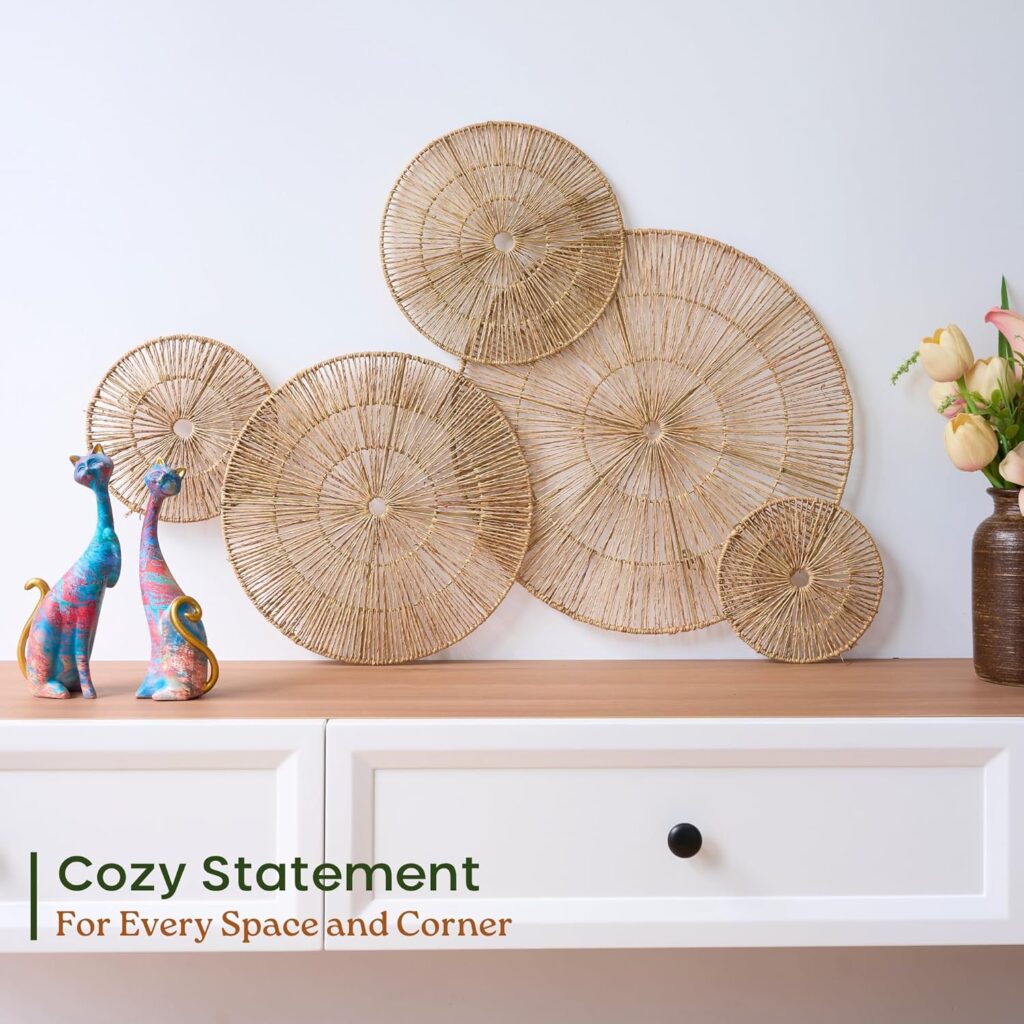
Find 01
Boho Jute Woven Wall Décor Set
A set of handcrafted circular woven discs in natural jute with a warm golden finish. Arrange them in any overlapping cluster — no nails needed for the larger setups. Instantly adds artisan depth to any wall.
The thing about natural-material wall art is that it does triple duty: it adds visual texture, it softens sound (especially in rooms with hard floors), and it brings an organic warmth that no print or canvas can replicate. If you’ve never thought about jute as a décor material, start here. It pairs with almost everything — cream sofas, dark woods, terracotta accents, white shelving.
Pro Styling Tip : When hanging woven wall discs, don’t centre them perfectly on the wall. Offset the cluster slightly left or right of a key anchor point (like a sideboard or fireplace). Asymmetry reads as intentional in boho interiors.
Step 2: Make the sofa irresistible
A couch is furniture. A couch with a blanket draped over it is an invitation. There’s a reason every shelter magazine, every hotel lobby, every aspirational living room shot features a throw. It says: come here, sit down, stay awhile.
I’d tried cotton throws before. They look fine, they wash well, they do the job. But when I draped the faux fur blanket I’d ordered over the arm of my sofa for the first time and actually sat under it while reading — I understood what all those interior accounts meant when they talked about “sensory layering.” This blanket is thick without being heavy, incredibly soft without pilling, and patterned in a way that makes it look like it belongs in a much more expensive room.

Find 02
Heavyweight, ultra-soft faux fur in a warm sand and charcoal animal print. Generously sized for both bed and sofa use. The kind of blanket that people ask about — and then reluctantly hand back.
The trick with a statement throw is in how you place it, not just where. Resist the urge to fold it neatly. Pull it slightly off-centre, let one end drape toward the floor, bunch a corner casually over the armrest. Staged untidiness is an art form. It signals: someone lives here, beautifully.
“A blanket on a sofa is the indoor equivalent of a welcome mat. It says: this is a place to rest.”
Step 3: Fix the light
I cannot overstate how much bad lighting ruins interiors. Overhead lighting — the single-source ceiling light — flattens everything. It removes shadow, removes depth, and makes even the most thoughtfully decorated room feel like a school gymnasium.
The solution isn’t just “add more light.” It’s about changing the angle and temperature of light. A floor lamp positioned in a corner creates what designers call “ambient pooling” — a warm glow that radiates upward and outward, creating depth and making a room feel larger and moodier at the same time.The vintage-style floor lamp I found checks every box: a dark bronze pole, an ornate urn-shaped collar, and a fabric shade that diffuses light into the warmest possible tone. It doesn’t light a room — it transforms one. I placed it between my bookshelf and my reading chair, and the corner it now illuminates looks like something from an editorial shoot.
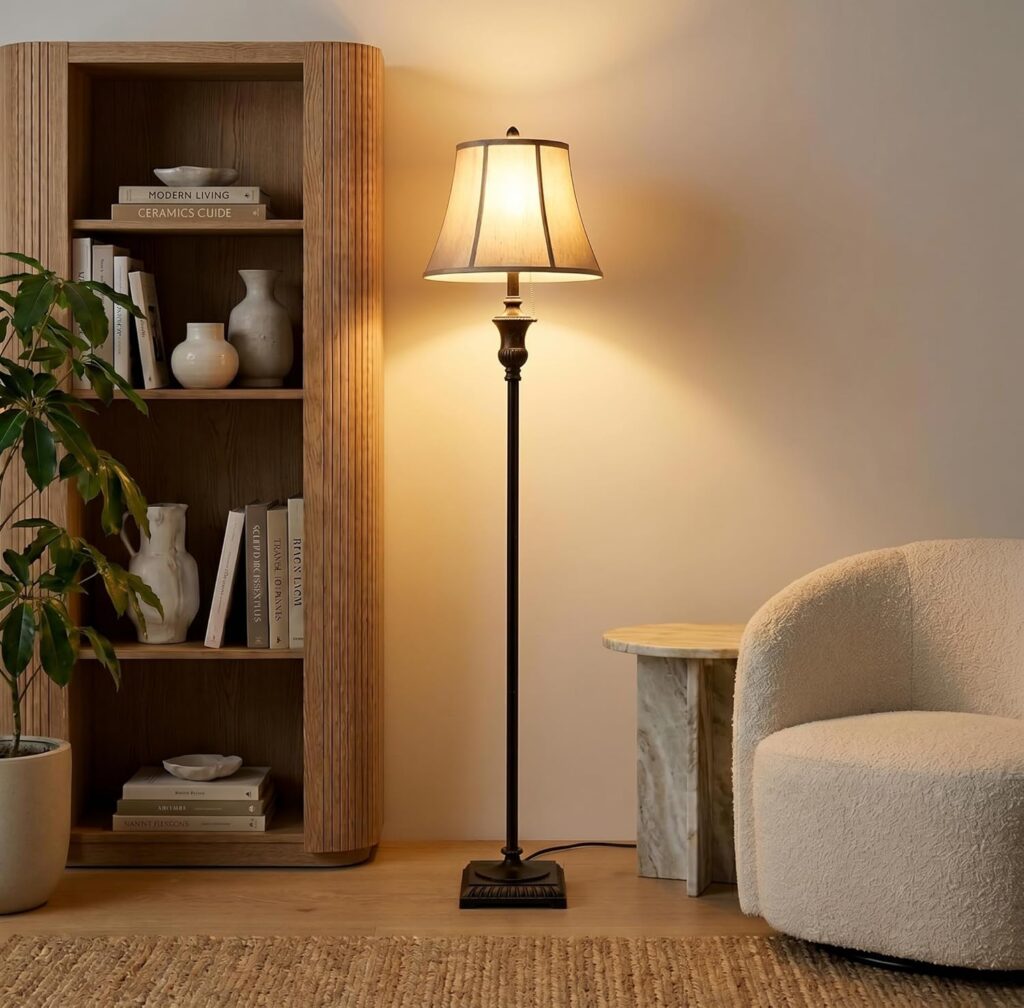
Find 03
A classic standing lamp with a dark oil-rubbed bronze finish, ornate column detailing, and a fabric bell shade. Emits warm ambient light perfect for reading nooks, bedroom corners, and living areas. Works with LED bulbs.The floor lamp also works as a vertical element — it draws the eye upward, making ceilings feel higher. If you only make one change in a room, honestly, change the lighting first. Everything else will immediately look better.
Lighting Rule to Live By :Use a 2700K–3000K warm white LED bulb in any floor lamp you want to feel cosy. Bulbs above 4000K read as “office.” Always aim for three light sources in a living room: overhead (dimmed), a floor lamp, and a table or accent lamp.
Step 4: Pile on the pillows (the right way)
Cushions are where most people either go too minimal or too chaotic. The secret is tonal layering — sticking to one texture family in varying shades so everything feels curated rather than collected.
These corduroy ribbed cushion covers were the last thing I added to my sofa, and they were the element that made everything else cohere. Three sizes, three tones within the same warm family — dark chocolate, caramel, and soft cream — all in the same wide-wale corduroy texture. The result looks like a professional styled it, but it’s three pillow covers that cost less than a dinner out.

Find 04
Corduroy Ribbed Cushion Covers
Wide-wale corduroy pillow covers with a star-point envelope design. Available in earth tones from ivory to deep brown. Machine washable and available in multiple sizes. The texture photographs beautifully and feels even better in person.
The corduroy texture is particularly clever in a winter or transitional setup — it has warmth baked into its visual appearance even before you touch it. Paired with the faux fur blanket, the combination of textures on the sofa creates what designers call a “tactile hierarchy.” It pulls people in. It makes a sofa look like somewhere you actually want to collapse into.
The room, after
I want to be honest with you: I did not expect four items from an Amazon cart to make the difference they did. I thought I needed a renovation, new furniture, a designer’s eye, a bigger budget. What I actually needed was to address the four foundational layers that every cosy room has — wall interest, textural softness, layered lighting, and tactile cushioning.
The boho jute wall discs gave my wall a voice. The faux fur blanket made the sofa somewhere you actually want to sit. The floor lamp retired the overhead light and replaced flat brightness with depth and warmth. The corduroy cushions pulled every shade in the room into a conversation with each other.
Together, they cost less than most single-item furniture purchases. And the room they created is one I genuinely don’t want to leave in the evenings.
Your cosy room checklist
Layer the walls — add a natural-material statement piece above a key furniture anchor
Introduce a statement throw — drape casually, not folded; let it look lived-in
Replace overhead-only lighting — add a floor lamp in a corner with a 2700K bulb
Cushion in tonal groups — one texture family, three tones, three sizes
Use odd numbers — three cushions, three discs, three light sources. Odd groupings always read more natural
Mix materials, not colours — keep a tight palette but vary between jute, faux fur, fabric, and wood for richness.
Cosy isn’t a budget thing. It isn’t even really a style thing. It’s the result of paying attention to the senses — what you see when you walk in, what you feel when you sit down, what the light does to the shadows in the corners. These four finds didn’t just redecorate my room. They reminded me what it’s supposed to feel like to actually be home.
This article contains affiliate links to products on Amazon.com. If you purchase through these links, I may earn a small commission at no additional cost to you. All products were personally selected and the opinions are entirely my own.
Read more: How I Finally Turned My Cold, Empty Living Room Into the Coziest Corner in the HouseWe’ve all been there: you wake up determined to overhaul your entire life. You vow to hit the gym for an hour every day, cook 100% organic meals, meditate for 20 minutes, and drink a gallon of water.
But by Wednesday? You’re exhausted, overwhelmed, and ordering takeout.
True health, fitness, and mental well-being don’t come from extreme, overnight transformations. They come from **micro-habits**—tiny, low-effort changes that compound over time into massive results.
If you are feeling sluggish, stressed, or disconnected from your body, here are 5 simple habits you can start today to completely reset your body and mind.
### 1. The “5-Minute Movement” Rule
You don’t need a grueling 60-minute gym session to benefit your body. When motivation is low, commit to just 5 minutes of movement.
* Do a quick morning stretch.
* Walk around the block during a lunch break.
* Do a few bodyweight squats while your coffee brews.
**Why it works: ** Movement releases endorphins that instantly boost your mood and lower cortisol (the stress hormone). More often than not, once you start moving for 5 minutes, you’ll actually want to keep going.
### 2. “Add, Don’t Restrict” Nutrition
Instead of focusing on what you need to cut out of your diet (which only triggers cravings and mental fatigue), focus on what you can *add*.
* Can you add a handful of spinach to your morning eggs?
* Can you add an extra glass of water before your afternoon coffee?
* Can you add a serving of berries to your dessert?
**Why it works: ** This shift from a scarcity mindset to an abundance mindset takes the anxiety out of eating while naturally crowding out less-nutritious options.
### 3. Protect Your First 30 Minutes
How you spend the first half-hour of your day sets the emotional tone for the rest of it. If the first thing you do is grab your phone and scroll through social media or work emails, you are immediately putting your brain into a reactive, stressed state.
* **The Reset: ** Try keeping your phone across the room or on “Do Not Disturb” for the first 30 minutes after waking up. Use that time to breathe, hydrate, or listen to music instead.
### 4. Practice “Box Breathing” for Stress Control
Mental wellness and physical wellness meet directly at the nervous system. When stress hits, your body goes into fight-or-flight mode. You can manually override this using your breath.
* **How to do it: ** Inhale for 4 seconds, hold for 4 seconds, exhale for 4 seconds, and hold empty for 4 seconds. Repeat these 3 to 4 times.
**Why it works: ** This simple technique instantly signals to your brain that you are safe, lowering your heart rate and clearing mental fog.
### 5. Clear Your Mind Before Bed (The Brain Dump)
If racing thoughts keep you awake at night, your physical fitness will suffer, too. Sleep is the ultimate foundation of health. Before your head hits the pillow, grab a notebook and spend two minutes writing down everything on your mind—to-do lists, anxieties, random thoughts.
**Why it works: ** Getting it out of your head and onto paper tells your brain, *”This is safe, we can deal with it tomorrow,”* allowing you to fall into a deeper, more restorative sleep.
### Small Steps, Big Results
You don’t have to do all five of these today. Pick **one** that resonates with you and try it out tomorrow. Remember, consistency beats intensity every single time.
We’ve all seen the flashy headlines promising miraculous weight loss in just a few days. They usually involve surviving on cabbage soup, drinking nothing but lemon water, or cutting out entire food groups.But let’s be honest: **starvation diets don’t work.** They leave you feeling exhausted, irritable, and constantly hungry. Worse, the moment you return to normal eating, the weight comes right back—often bringing a few extra pounds with it.
If you want to know how to start losing weight safely with absolutely *zero* starvation, you’re in the right place. This guide is all about building a body you love while still enjoying the food you eat.
## 1. Ditch the “Less is More” Mindset (Eat More Volumes)
Losing weight safely isn’t about eating less food; it’s about eating the *right* food.
When you starve your body, your metabolism slows down to protect itself. Instead of restricting your portions to tiny, unsatisfying amounts, focus on **Volume Eating**. This means filling your plate with low-calorie, nutrient-dense foods that physically fill your stomach.
* **Load up on veggies:** Broccoli, spinach, cucumbers, and bell peppers add massive volume to your meals for very few calories.
* **Prioritize lean protein:** Chicken breast, turkey, tofu, eggs, and fish keep you full because protein suppresses hunger hormones.
* **Don’t skip fiber:** Oats, beans, and whole grains digest slowly, preventing those sudden energy crashes and sugar cravings.
## 2. Stop Counting “Flawlessness,” Start Counting Consistency
You don’t need a perfect diet to see incredible results. In fact, trying to be 100% perfect usually leads to a binge-and-restrict cycle.
Aim for the **80/20 rule**:
* **80%** of your diet should come from whole, nutritious foods.
* **20%** can be reserved for the treats and foods you genuinely love.
By allowing yourself a little flexibility, you remove the psychological pressure of “dieting,” making your weight loss journey feel lifestyle-oriented rather than punitive.
## 3. Hydrate Wisely
Sometimes, our brains confuse thirst with hunger. Before you reach for a mid-afternoon snack, try drinking a glass of water and waiting 15 minutes.
Additionally, swapping out liquid calories (like sodas, sugary coffee drinks, and juices) for water, herbal tea, or black coffee is one of the easiest ways to cut hundreds of hidden calories a week without feeling a single pang of hunger.
## 4. Move in a Way That Brings You Joy
You do not have to suffer through grueling, hours-long gym sessions to lose weight. If you hate running, don’t run!
Sustainable weight loss relies on consistent movement. Find an activity you actually look forward to:
* A brisk 30-minute daily walk while listening to your favorite podcast.
* A fun dance workout in your living room.
* Strength training 2–3 times a week to build lean muscle (which actually helps burn more fat at rest!).
